
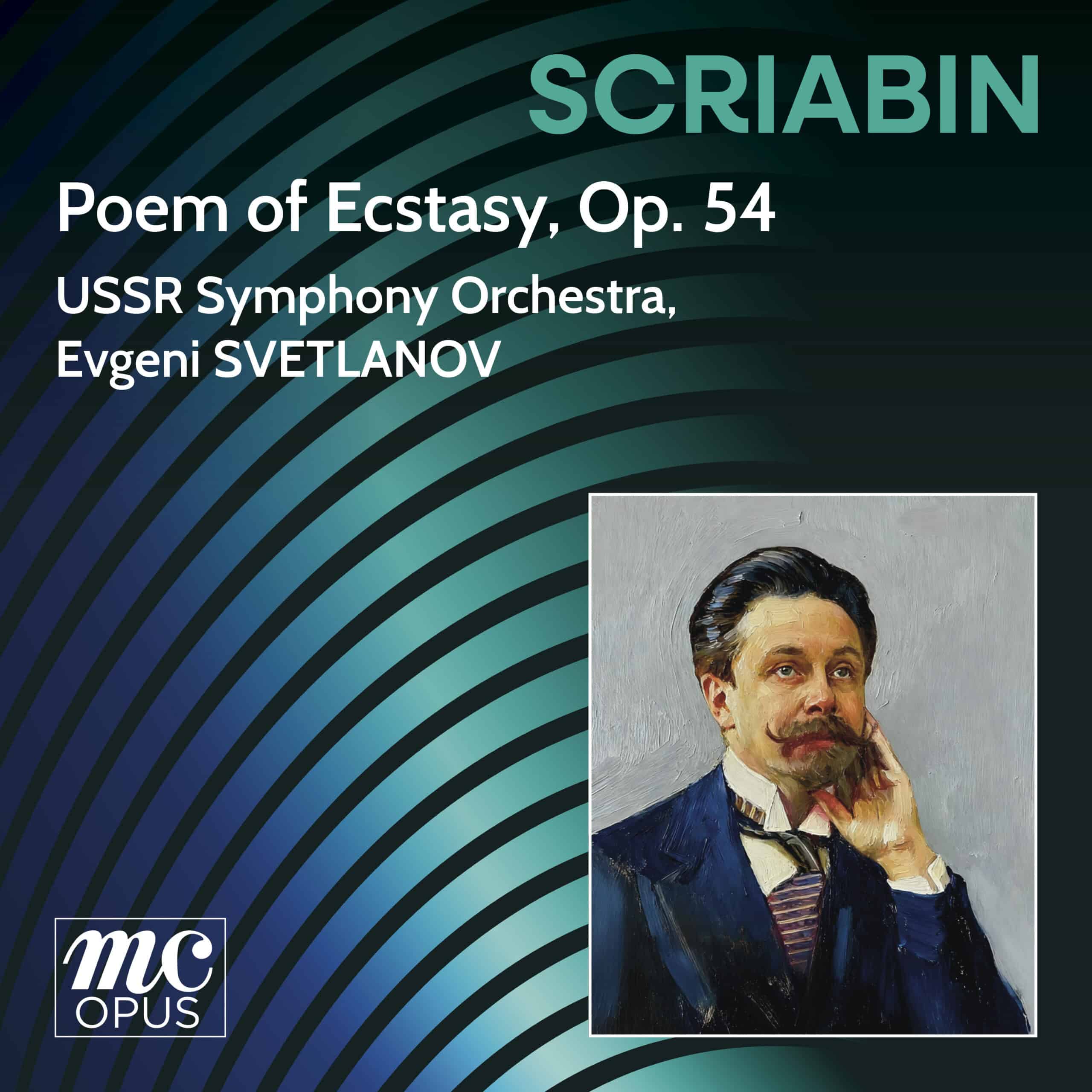









Poem of Ecstasy is Scriabin’s most popular orchestral work and was played on Soviet radio when cosmonaut Yuri Gagarin first blasted into space in 1961. This Romantic/Impressionist/Symbolist work of 1908 is in one movement and represents a synthesis between a symphony and a tone poem. The composition of the work — which he once suggested might be his “Fourth Symphony” — coincided with the abortive revolution of 1905 in Russia. For a while, Scriabin became convinced that the revolutionaries shared his ideas, but later came to the messianic conclusion that society could only be truly transformed through his own art.
It was composed during Scriabin’s most active period of involvement with the mystical Theosophical Society, and may also reflect the influence of the composer’s synaesthesia (the ability to perceive colours whilst hearing tones), with particular instruments corresponding to human emotions and actions: flute (yearning), muted trombone (protest), muted horns (apprehension), and trumpets (will and self-assertion). In this massively-chorded work — which features a series of increasingly intense climaxes — Scriabin expresses the ecstasy, both spiritual and sexual, of the creative spirit. The work was first performed in New York on 10 December 1908, conducted by Modest Altschuler.
The Poem of Ecstasy can perhaps be seen as a prelude to Scriabin’s planned epic Mysterium: a week-long happening in the Himalayas, involving all the senses and culminating in the end of the world in a state of euphoric bliss. It was not to be. On a visit to London in 1914, the composer noticed a pimple on his lip which eventually became septic and caused his death in 1915, during the First World War. The composer Nikolai Myaskovsky — whose early orchestral works clearly show Scriabin’s influence — wrote that the composer’s premature death was “terrible… and just as absurd as the War itself.”
